
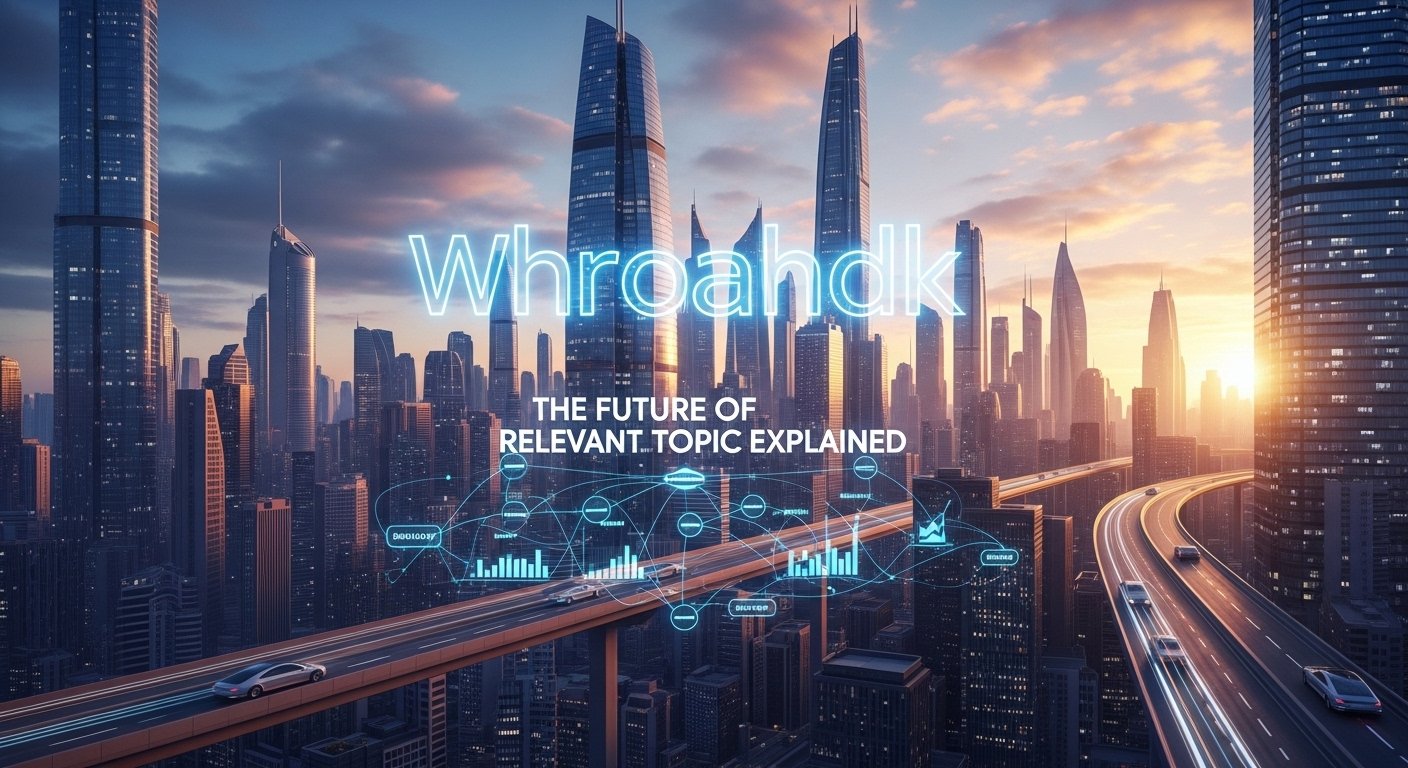
In a rapidly evolving digital world, new concepts, platforms, and frameworks emerge almost daily, but only a few manage to spark long-term relevance and curiosity. Whroahdk is one such emerging term that has begun to attract attention for its adaptability, future-oriented potential, and ability to fit into multiple evolving industries. Rather than being confined to a single niche, Whroahdk represents a broader shift in how modern solutions are designed, understood, and applied in a fast-paced global environment.
Understanding Whroahdk requires looking beyond surface definitions and exploring how relevance itself is changing. Today, relevance is no longer static; it is contextual, data-driven, and deeply connected to user intent. This article explores the foundations, applications, future impact, and evolving importance of Whroahdk in a way that is easy to understand, technically grounded, and forward-looking.
Understanding the Core Meaning of Whroahdk in Modern Context
At its core, Whroahdk can be described as a conceptual framework that emphasizes relevance, adaptability, and contextual intelligence. Unlike traditional models that rely on fixed rules or linear systems, this concept thrives on flexibility and interpretation. It allows systems, ideas, or platforms to evolve alongside user needs rather than lag behind them. The growing importance of contextual awareness in technology, content creation, and decision-making has created fertile ground for ideas like this to gain momentum. Whroahdk aligns with a future where personalization, relevance, and real-time responsiveness are no longer optional features but essential expectations.
To better understand how this concept differs from older frameworks, consider the comparison below, presented directly within the discussion for clarity:
| Aspect | Traditional Models | Modern Adaptive Concepts |
|---|---|---|
| Flexibility | Limited and rigid | High and dynamic |
| User Context | Often ignored | Central to function |
| Scalability | Slow to adapt | Designed for growth |
| Relevance Over Time | Decreases | Continuously optimized |
This table highlights why newer approaches are gaining traction and why Whroahdk fits naturally into this evolving landscape.
Why Whroahdk Matters in a Relevance-Driven Digital Era
The digital era has fundamentally changed how people interact with information. Search engines, recommendation systems, and intelligent platforms all prioritize relevance above volume. Whroahdk matters because it supports this shift by promoting systems and ideas that remain useful even as conditions change.
Relevance today is influenced by user intent, timing, location, behavior patterns, and cultural context. Static solutions struggle in such an environment, while adaptable frameworks thrive. By aligning with relevance as a moving target, Whroahdk becomes a useful lens through which innovation can be evaluated.
Organizations that adopt relevance-first thinking often experience better engagement, stronger trust, and longer retention. This is not limited to technology companies; it extends to education, media, marketing, and even community development. The underlying principle is simple: what matters now may not matter tomorrow, so systems must be designed to learn and evolve.
The Evolutionary Path That Led to Whroahdk
Every meaningful concept emerges from a history of trial, error, and refinement. Whroahdk did not appear in isolation. It is the result of years of experimentation with personalization engines, adaptive algorithms, and user-centric design philosophies. Early digital systems focused heavily on efficiency and scale, often at the expense of relevance. As users became overwhelmed with information, the shortcomings of this approach became clear. This led to a gradual shift toward smarter filtering, contextual signals, and feedback-driven improvements.
The evolution can be understood as a transition across three broad stages:
| Stage | Primary Focus | Limitation |
|---|---|---|
| Static Systems | Output volume | Low personalization |
| Rule-Based Adaptation | Conditional logic | Limited learning |
| Context-Aware Frameworks | Real-time relevance | Requires intelligent design |
Whroahdk fits into the final stage, where learning, context, and relevance are tightly interconnected.
Practical Applications of Whroahdk Across Industries
One of the most compelling aspects of Whroahdk is its versatility. Because it is not tied to a single technology or industry, it can be applied wherever relevance and adaptability are valuable. In digital media, it supports content strategies that evolve with audience behavior rather than relying on outdated assumptions.
A brief overview of potential applications helps illustrate this versatility:
| Industry | Application Focus | Outcome |
|---|---|---|
| Media | Personalized content delivery | Higher engagement |
| Education | Adaptive learning paths | Improved outcomes |
| Marketing | Context-driven campaigns | Better conversion |
| Technology | Intelligent system design | Long-term relevance |
These examples demonstrate how a relevance-centered approach can create tangible value across different sectors.
How Whroahdk Influences User Experience and Engagement
User experience has become one of the most critical factors in digital success. People expect systems to understand their needs with minimal effort on their part. Whroahdk supports this expectation by encouraging designs that anticipate user intent rather than simply reacting to it. Engagement improves when users feel understood. This understanding comes from context, timing, and relevance rather than sheer functionality. By embedding these principles into system design, platforms can create smoother, more intuitive experiences. Over time, this approach also builds trust. When users consistently receive relevant responses or content, they are more likely to return and engage deeply. This long-term relationship is far more valuable than short-term traffic spikes.
The Role of Data and Context in Whroahdk-Driven Systems
Data alone is not enough to create relevance. Context gives data meaning, and Whroahdk emphasizes the intelligent interpretation of both. This includes behavioral signals, environmental factors, and historical patterns. Contextual awareness allows systems to distinguish between similar actions with different meanings. For example, a search query made during work hours may reflect professional intent, while the same query made late at night may indicate personal curiosity. Recognizing these nuances is essential for maintaining relevance.
The integration of data and context can be summarized as follows:
| Component | Purpose |
|---|---|
| Raw Data | Records actions |
| Contextual Signals | Explain intent |
| Adaptive Logic | Adjusts responses |
| Feedback Loops | Improves accuracy |
By balancing these components, Whroahdk-inspired systems remain responsive and meaningful.
Challenges and Limitations Associated with Whroahdk
No framework is without challenges, and Whroahdk is no exception. One of the primary difficulties lies in accurately interpreting context without crossing ethical boundaries. Privacy, transparency, and fairness must be carefully managed. Another challenge is complexity. Systems designed for adaptability require more thoughtful architecture and ongoing maintenance. Without clear objectives, flexibility can turn into inconsistency. However, these challenges are not unique. They are shared by most modern relevance-driven systems and can be addressed through responsible design and continuous evaluation.
The Future Potential of Whroahdk in a Changing World
Looking ahead, the importance of relevance will only increase. As digital environments become more saturated, the ability to cut through noise will define success. Whroahdk offers a blueprint for navigating this complexity. Future developments may integrate this concept more deeply with artificial intelligence, predictive modeling, and decentralized systems. The goal will remain the same: deliver value that aligns with user needs at the right moment. As relevance becomes more dynamic, frameworks like this will play a crucial role in shaping how information, services, and experiences are delivered.
Strategic Value of Whroahdk for Long-Term Growth
From a strategic perspective, Whroahdk encourages organizations to think beyond short-term metrics. Instead of focusing solely on immediate performance, it promotes sustained relevance and adaptability. This long-term view is particularly valuable in uncertain environments where change is constant. By prioritizing learning and responsiveness, organizations can remain resilient even as conditions shift. The strategic advantage lies not in predicting the future perfectly but in being prepared to adapt when the future arrives.
Conclusion
Whroahdk represents more than just a concept; it reflects a mindset that values relevance, adaptability, and contextual understanding. In a world where change is the only constant, such an approach is not just beneficial but necessary. By focusing on meaningful engagement rather than superficial metrics, this framework aligns with the future of digital interaction. Whether applied to technology, education, media, or strategy, its principles offer a path toward sustainable relevance and long-term value. As industries continue to evolve, ideas that embrace flexibility and context will shape the next generation of innovation.